

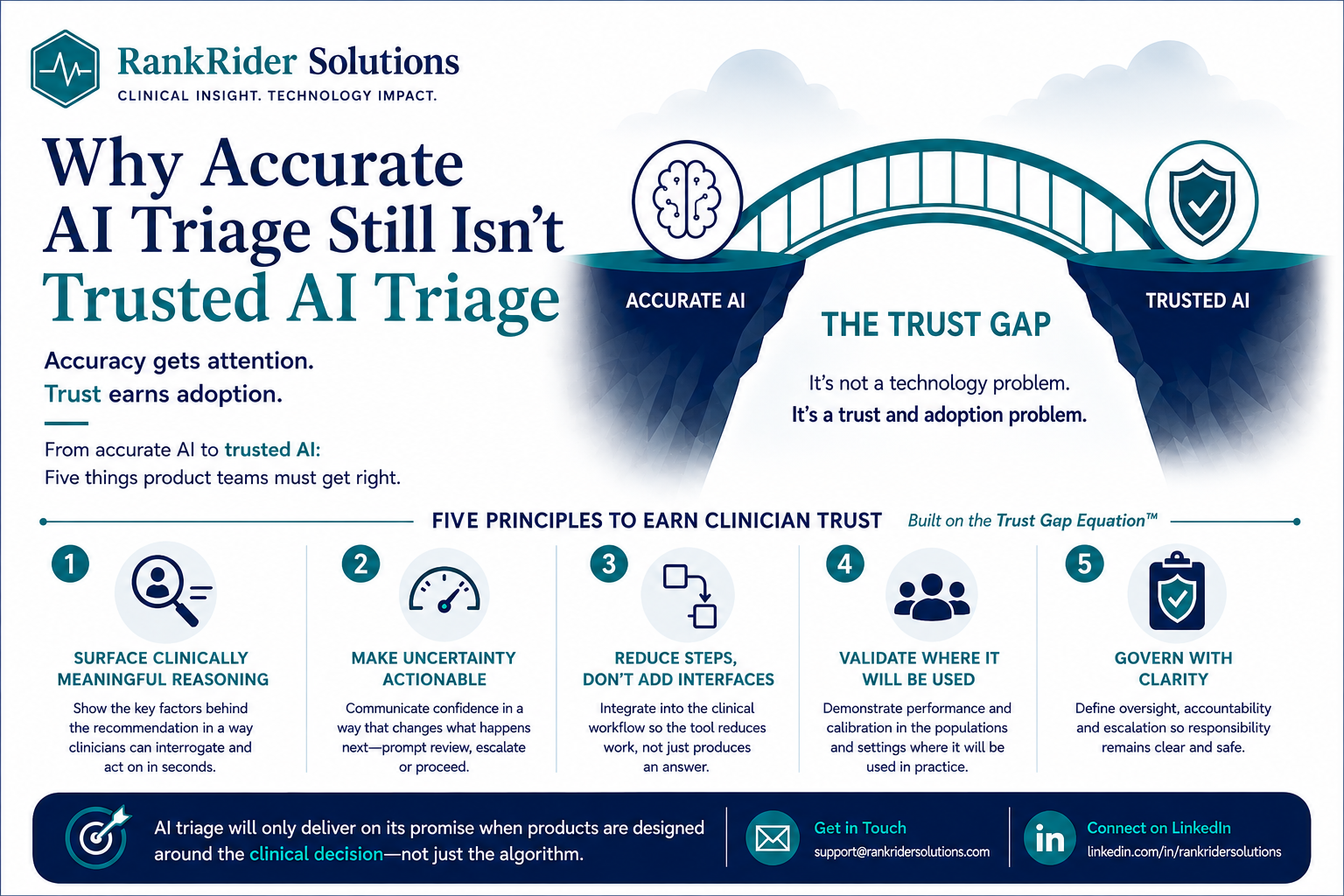
Why Accurate AI Triage Still Isn’t Trusted AI Triage
A patient walks into the emergency department with mild chest pain. Nothing dramatic, nothing
that immediately signals a time-critical emergency.
But the ECG changes the picture: an acute myocardial infarction requiring urgent, time-critical treatment.
Before that result, the same presentation could plausibly have gone several ways: safe to wait in ambulatory care, a straightforward move to majors, or, as it turns out, urgent treatment now. One finding changes the entire clinical trajectory, and it changes it between three genuinely different pathways, not two.
That three-way judgement is one of the harder parts of triage. The difficult cases are not always the ones that look obviously unwell. Sometimes the important clinical task is recognising when an apparently familiar presentation contains something that breaks the expected pattern, a needle in a haystack of mild-looking presentations.
This is also where the challenge for AI-supported triage becomes more complicated. Healthcare AI has understandably invested heavily in predictive accuracy, and accuracy matters. But accuracy alone does not create the conditions for clinical trust and adoption. A model can perform well across a population and still leave the clinician asking a much more immediate question:
Why should I trust this recommendation for this patient?
Research across NHS trusts, clinicians and the academic literature shows a consistent pattern here: most clinicians report low to moderate trust in current AI triage tools. Strong model performance therefore does not automatically translate into sustained clinical use, particularly when transparency, workflow integration, usability and governance remain unresolved.
The clinical problem: speed without trust can add work
Many AI triage systems are developed around legitimate goals: faster assessment, better risk stratification and more consistent identification of clinical risk. But technical performance and clinical usefulness are not the same thing.
When an AI system produces a recommendation without enough clinically meaningful information to interrogate it, the clinician still has to decide whether that recommendation is safe to act on.
So they verify it.
They review the history, observations, investigations and clinical context, reconstruct the decision independently, and compare it with their own judgement before deciding what happens next.
The workflow can therefore become:
AI recommendation → clinician verification → clinical decision
rather than the intended:
AI-supported assessment → clinical decision
That distinction matters.
If the clinician has to repeat the reasoning independently before acting on the output, the system may add verification and context-switching to an already demanding workflow rather than reducing cognitive work.
This helps explain why technically promising tools can struggle to progress from demonstration or pilot use into sustained clinical practice. If the verification burden is greater than the time or cognitive effort the tool saves, strong model performance alone may not be enough to drive adoption.
The question for product teams is therefore not only:
How accurate is the model?
It is also:
What does the clinician need to see, understand and trust before this output can genuinely reduce work?
Why clinicians hesitate: the Three Drivers of Clinical Distrust™
Three recurring problems help explain why technically capable systems may still create hesitation at the point of care.
RankRider’s Three Drivers of Clinical Distrust™ name them as Black Box Decisions, Edge Case Anxiety and Accountability Without Liability. Together, they form the triangle underneath the Trust Gap.
Black Box Decisions
A recommendation without clinically meaningful reasoning creates an obvious question:
Why did the system say this?
Clinicians are trained to interrogate reasoning, examining whether the history fits the diagnosis, whether observations support it, whether investigations change it and whether something important does not fit.
An AI output that cannot be interrogated in a clinically useful way sits awkwardly within that process, regardless of its overall accuracy.
The product challenge is therefore not simply to produce an answer. It is to provide enough relevant information for the clinician to evaluate that answer efficiently.
Edge Case Anxiety
Clinical presentations do not behave uniformly.
The patient with significant pathology does not always look significantly unwell. Symptoms overlap, comorbidities alter presentations, and important cases can sit outside the expected pattern, as with the chest pain example above.
A system that communicates the same apparent certainty across very different presentations risks creating false reassurance.
A more clinically credible system needs to recognise when the pattern is strong, when it is weak and when something does not fit well enough for the recommendation to be treated in the same way.
Accountability Without Liability
In current clinical practice, the clinician using the recommendation retains professional responsibility for the decision they make.
That creates an important asymmetry when an AI system influences the decision but provides limited visibility into how its recommendation was reached.
The issue is not that clinicians are inherently resistant to technology. Caution is rational when responsibility remains human, but part of the decision-making process is difficult to interrogate.
The design question becomes:
How much visibility does the clinician need to use the system without simply repeating the assessment independently?
That is where trust becomes a product problem rather than an abstract attitude towards AI.
Accuracy Is Necessary. Calibrated Confidence Makes AI Usable.
One way to address the trust challenge is through better confidence calibration.
A well-calibrated AI system should communicate uncertainty in a way that reflects its actual performance. When a model expresses high confidence, it should be reliably more likely to be correct than when it expresses lower confidence.
The clinical parallel is familiar.
A colleague who says, “This fits clearly,” is communicating something very different from someone who says, “Something doesn’t fit here. I think this needs another look.”
Clinical reasoning naturally involves uncertainty. AI-supported reasoning needs to communicate that uncertainty in a meaningful way too.
This does not mean displaying a percentage beside every recommendation and assuming the trust problem has been solved. A confidence score without context can simply become another number for the clinician to interpret.
The more important question is whether the system communicates uncertainty in a way that helps the clinician decide what to do next.
For example:
- High confidence + familiar pattern → support the expected pathway
- Lower confidence + conflicting features → prompt clinical review
- Pattern-breaking feature → escalate attention
- Outside validated use → make the limitation explicit
The objective is not to make AI appear certain.
It is to make its uncertainty clinically useful.
Clinical Trust Requires More Than Model Performance
Accuracy remains fundamental, but clinical trust cannot be reduced to a single performance metric.
In the Trust Gap Equation™, clinical trust depends on five interacting elements:
Clinical Trust = Accuracy + Explainability + Confidence Calibration + Workflow Integration + Governance
A weakness in any one of these areas can change how a technically strong system is experienced in practice.
A highly accurate model that cannot explain its recommendation may create additional verification work.
An explainable model that disrupts clinical workflow may not be used consistently.
A well-integrated system that communicates its limitations poorly may create inappropriate confidence.
And a technically capable system without clear governance can leave unresolved questions around responsibility, escalation and clinical oversight.
The product therefore needs to be designed around the clinical decision surrounding the model, not simply around the model itself.
What Product Teams Can Do Differently
The solution is not to add more information around an AI output.
It is to design the output around the clinical decision that needs to be made.
Four principles are particularly important.
1. Surface Clinically Meaningful Reasoning at the Point of Decision
A validation report demonstrating strong aggregate performance is important, but it does not answer the clinician’s immediate question about the patient in front of them.
Clinicians need meaningful information about the factors contributing to an AI recommendation, presented in a form they can evaluate against their own assessment in seconds rather than minutes.
The goal is not to expose every technical feature of the model.
It is to provide the information that helps the clinician determine whether the recommendation makes clinical sense.
2. Make Uncertainty Actionable
Confidence calibration should influence what happens next.
If a system is less reliable in a particular context, that limitation should not be buried in technical documentation.
The product should have an appropriate response to uncertainty. This might include prompting clinical review, highlighting conflicting information, making limitations visible or escalating attention when a presentation falls outside the conditions in which the system has demonstrated reliable performance.
A system that knows when not to behave as though it is certain may ultimately be more useful than one designed to produce an answer in every situation.
3. Reduce Steps Rather Than Add Another Interface
A clinically useful AI tool should reduce cognitive and operational workload.
If a clinician has to leave the primary workflow, open another interface, interpret an AI output, return to the clinical system and then reconstruct the decision for documentation, the technology has added work.
That is workflow addition, not workflow integration.
Product teams should examine the complete decision pathway:
- Where does the clinician encounter the AI output?
- What must they do before they can act on it?
- What information do they need to verify elsewhere?
- Does the system remove a step or create one?
The relevant measure is not simply how quickly the algorithm produces an answer.
The real question is whether the entire clinical decision becomes easier, safer or more efficient.
4. Validate Where the Product Will Actually Be Used
Headline accuracy from a validation population does not automatically establish how a system will perform in another clinical setting.
Patient demographics, disease prevalence, referral pathways and clinical workflows can vary significantly between populations and healthcare environments.
For NHS buyers, this creates an important procurement question:
Has the system’s performance and calibration been demonstrated in populations and settings relevant to where it will actually be used?
For product teams, local relevance should therefore be considered during development and validation, rather than treated simply as evidence to assemble before procurement.
5. Govern with clarity
Accuracy, explainability, calibration and workflow fit can all be strong, and adoption can still stall if nobody has answered a more basic question: what happens when the system gets it wrong?
Every clinical AI system will produce incorrect recommendations at some point. The governance question is not whether this happens, but whether there is a defined, tested pathway for when it does. Who pauses the tool? Who investigates? Who approves resumption? If a clinician cannot answer these questions before they start using the system, they will rationally build their own informal safeguard around it, which is exactly the extra verification work the rest of this article has been describing.
Governance also has to be continuous, not a one-off validation exercise before launch. Patient populations, presentation patterns and clinical pathways shift over time, so a credible governance framework includes ongoing performance monitoring against defined clinical metrics, not just a pilot-stage sign-off. Capturing near misses, cases where a clinician overrode the AI and was right to, is part of this too, since that feedback loop is what improves both the tool and clinician confidence in it.
None of this needs to be complicated, but it does need to be explicit and visible before procurement asks for it, not produced reactively after an incident. Product teams that treat governance as a design requirement, not a compliance checkbox added at the end, are the ones that will find clinical adoption genuinely sustainable rather than provisional.
Build Trust Into the Product, Not Around It
Explainability, calibration and workflow integration should not be compliance layers added after the model has been built.
They are product requirements.
That means involving clinicians during problem definition, rather than simply presenting a finished prototype for feedback.
It means asking how uncertainty should influence the next clinical action before deciding how confidence should be displayed.
It means testing whether the system actually reduces verification work, rather than assuming that a faster prediction automatically creates a faster clinical decision.
And it means being transparent about where performance is weaker, as well as where it is strongest.
This is the distinction between designing an accurate algorithm and designing clinically usable decision support.
The first asks:
Can the model make the prediction?
The second asks:
Can the clinician use that prediction safely and efficiently within the real clinical workflow?
Health-tech companies need to answer both.
From Accurate AI to Trusted AI
The immediate opportunity for AI triage is not simply greater autonomy.
It is decision support that clinicians can interrogate, understand and use at the point of care.
Accuracy remains essential, but it is the beginning of the adoption challenge, not the end of it.
The products most likely to earn sustained clinical use will be those designed not only to perform well, but also to communicate uncertainty, fit naturally into clinical workflows and support the judgement of the clinician ultimately responsible for the decision.
For AI triage, the question is no longer simply whether the model can get the answer right.
The more important question is whether the product has been designed so that a clinician can understand when, why and how much to trust that answer.
About the Report
This article draws on RankRider Solutions’ 2026 industry report, The Trust Gap in AI Triage: Why AI Cannot Yet Replace Clinical Judgement in Emergency Pathway Decisions and What Health-Tech Must Do Next.
If your organisation is developing an AI triage or clinical decision-support product and wants to understand where clinical trust and adoption barriers may arise and what practical changes could address them, contact RankRider Solutions at support@rankridersolutions.com.